
Bookkeeping for Contractors and Trades in Northeast Indiana
You can't tell which jobs actually made money. Let's fix that first.
Most contractors I meet know their bank balance and know they're busy. What they can't tell me is which of last quarter's jobs made money and which one quietly ate the profit from the other three.
That's not a discipline problem. It's a bookkeeping problem. Contractor books break in specific ways — deposits recorded as income, change orders never billed, retainage sitting in the wrong account, subs paid without a W-9 on file, material costs landing in one big bucket called "Job Supplies." A generic bookkeeper using the default QuickBooks chart of accounts will keep those books tidy and still leave you blind.
I set QuickBooks Online up the way a construction business actually runs, then work the file every week so you know where you stand before the job is over instead of after.
Who I work with:
Residential and commercial general contractors. Remodelers. Electricians, plumbers, and HVAC. Concrete, excavation, and site work. Roofing and siding. Painters and drywall. Landscape and hardscape. Property managers running maintenance crews.
Typically one to twenty employees, working on a mix of fixed-price and time-and-material jobs, running one or two crews, with subs in and out all year.
What I handle that a general bookkeeper usually doesn't
Job costing that you can actually read.
Every dollar of labor, material, subcontractor cost, and equipment gets tagged to the job it belongs to. You get profit by job, not just profit for the month. When you're deciding whether to bid the next one like the last one, that's the number you need.
Progress billing and retainage.
Draw schedules tracked against the contract. Retainage held by a general contractor or an owner recorded as a receivable so it stops disappearing from your books — and so you notice when nobody has released it.
Change orders that get billed.
Change orders are where contractor margin goes to die. I track approved change orders against what's been invoiced and flag the gap while you can still collect.
Indiana sales and use tax on materials.
Whether you collect sales tax from your customer or pay it on purchase depends on how your contract is written. Under Indiana Department of Revenue guidance, a contractor working under a time-and-material contract is generally treated as a retail merchant selling the materials it installs and must register and collect sales tax on the material portion, while a lump-sum contractor generally pays sales or use tax on its own materials and doesn't collect from the customer. Get that backwards on either side and it's expensive. I make sure your books match the contracts you're actually signing, and that Form ST-105 exemption certificates are on file where they belong on exempt work.
Equipment and vehicles recorded as assets.
Trucks, trailers, skid steers, and tools capitalized and depreciated correctly, with loan principal and interest split — not dumped into expenses where they wreck your profit picture and your tax return.
Customer deposits handled correctly.
Money collected before work starts is a liability, not revenue. Recording deposits as income inflates your profit, overstates what you owe in taxes, and makes a good month look like a great one. I keep deposits in the right place until the work is earned.
Work in progress, tracked honestly.
For fixed-price jobs, over- and under-billing get reviewed so your P&L reflects the work you've actually completed. This is the single biggest reason contractor financials look great in one month and terrible in the next.
Subcontractor compliance, all year instead of every January.
W-9 collected before the first check goes out. Certificates of insurance tracked. 1099-NEC totals accurate all year long, so January is a printing job and not an emergency.
Payroll set up for Allen County reality.
Allen County's local income tax rate is 1.59%, confirmed for 2026 in the Department of Revenue's county rate notice. If you have crew living across the Ohio or Michigan line, Indiana has reciprocity agreements with Ohio, Michigan, Kentucky, Pennsylvania, and Wisconsin, and those employees file Form WH-47, Certificate of Residence so Indiana state tax isn't withheld — but that form doesn't exempt them from county tax. I set withholding up so it's right the first time rather than fixed in a W-2 correction.
Behind on your books?
That's most first conversations. Whether you're two months behind or two years, I'll tell you exactly what it takes to catch up, quote it as a fixed price before I start, and get you current — most clients are caught up within 2 to 4 weeks depending on how far back it goes. No lectures.
What this costs
Weekly bookkeeping starts at $250.00 per month. Three tiers, flat monthly fee, no hourly billing for ongoing work. Catch-up and cleanup are quoted separately as a fixed-price project so you know the number before anything starts.
Your books, ready for whoever files your taxes
I keep your file tax-ready and coordinate directly with your CPA or tax preparer, so they get clean numbers instead of a shoebox and a bill for sorting it out. Don't have one? I'll introduce you to someone I trust.
Start here
Book a free Game Plan Call. Thirty minutes. We'll look at where your books actually are, what's missing, and what it takes to get profit-by-job in front of you. You'll get a written one-page plan either way.
Or call or text 260-246-7803. Based in Ossian, working with contractors across Allen, Wells, Adams, Huntington, DeKalb, and Whitley counties.
Questions contractors ask
Do I need job costing if I only run a few jobs at a time?
Especially then. With a handful of jobs, one bad one is a big share of your year. Job costing is how you find out which kind of work to stop bidding.
I already have QuickBooks. Is it a mess?
Probably fixable. I'll do a review, tell you whether it needs a cleanup or a rebuild, and quote either one as a fixed price.
Do you do my taxes?
No — bookkeeping and reporting are what I do, and I do them weekly. I keep the file tax-ready and work directly with your preparer.
Can you handle my payroll?
Yes, including crew across state lines, county tax setup, and 1099 subs.
I'm not in Fort Wayne. Does that matter?
No. Most of the work is remote. I'm in Ossian and happy to meet in person around Northeast Indiana, and I work with clients in Michigan and Minnesota too.
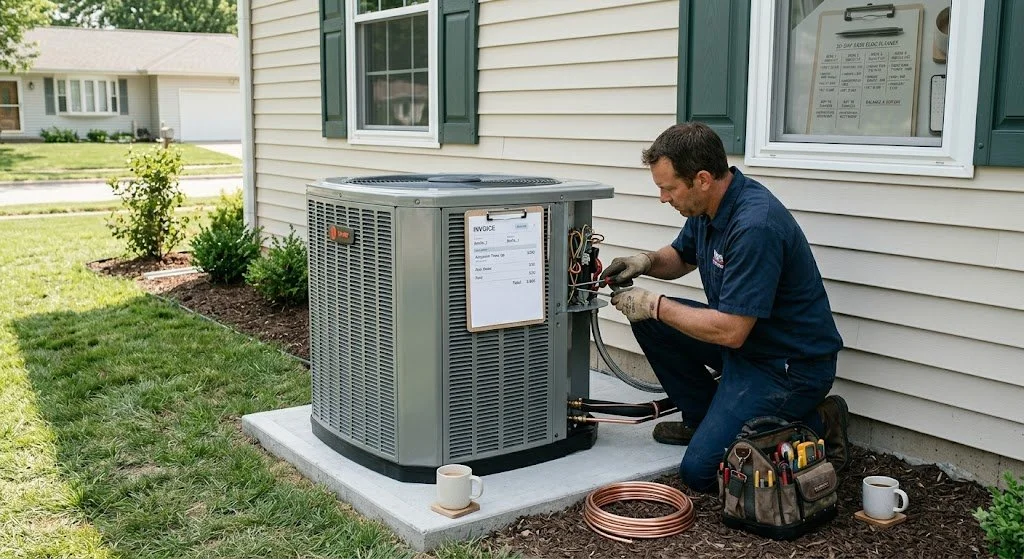
Why Profitable HVAC Calls Still Leave You Short on Cash
Profitable jobs, thin bank account? Here's why cash flow and profit aren't the same for HVAC contractors — and five fixes …….