
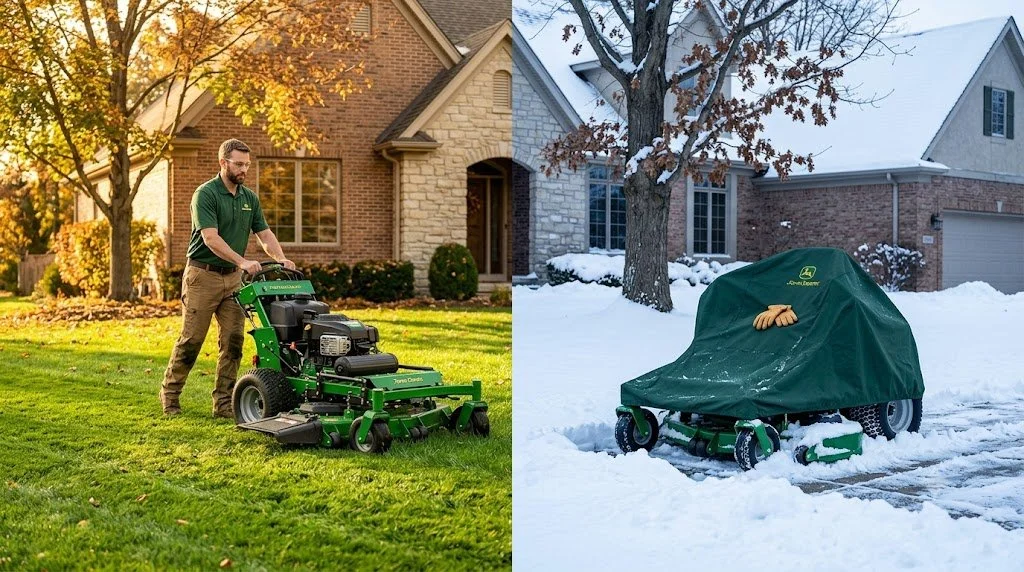
From busy season to slow season: lawn care businesses face a real cash flow gap every winter.
If you run a lawn care or landscaping business, you already know the feeling. Business is booming from April to October, and then November hits and the phone stops ringing. Bills don't stop, though — and that gap is where a lot of good companies get into trouble.
You are not alone in this. When lawn care owners talk about their biggest challenge online, winter income comes up more than almost anything else. One longtime landscape company owner put it simply: "the number 1 problem is bringing in income during the winter.” Another owner shared that his income drops from around $10,000 a month during the busy season to just $3,000-$4,000 in the cold months.
The good news: this is a solvable problem. You just need a plan before winter shows up, not after.
Why Winter Feels So Much Scarier Than It Should

As fall turns to winter, many lawn care owners start feeling the pinch of slower income.
As fall turns to winter, many lawn care owners start feeling the pinch of slower income.
Here's the trap. During your busy months, money is flowing in, so it feels like things are going great. But if you spend like every month is a busy month, you'll have nothing left when the work dries up.
One owner described the drop off honestly: "There's definitely a dip of about 50% in late January through early March. I just made sure to spend less in that time and got myself to spring time."
That's the right instinct, but "just spend less" isn't a full plan. You need to know two things ahead of time: how much you'll be short, and where that money is going to come from. That's what a cash reserve is for.

A cash reserve works like a winter coat for your business — set aside before you need it.
What Is a Cash Reserve (In Plain English)
Think of a cash reserve as your business's winter coat. It's money you set aside during the busy months so you're not scrambling when work slows down. It's not an investment, not a loan, and not "extra profit" — it's simply cash sitting in a separate account, waiting for the months you'll need it.
The key word is "separate." If this money sits in the same account you pay bills from every day, you will spend it without meaning to. Open a second business savings account and treat it like it's off-limits until winter.
How Much Should You Actually Save?
You don't need to guess. Here's a simple way to figure out your number:
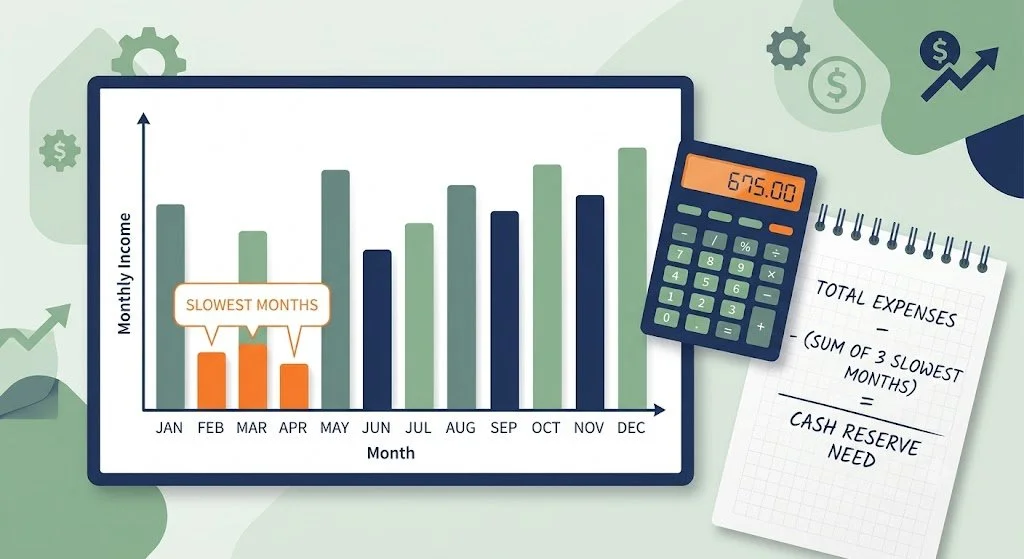
Calculate your cash reserve target by looking at your three slowest months, not the average.
Look back at your slowest 3-4 months last year. Add up what actually came in during those months.
Add up what you had to pay out during those same months — rent, insurance, loan payments, any crew you kept on, your own paycheck.
Subtract the two. That gap is what your cash reserve needs to cover.
Real owners use this exact approach. One shared: "it's wise to create the off-season budget based on the lowest-performing three months rather than relying on an average month.” Using your average month will trick you into thinking you need less than you actually do — always plan around your worst months, not your typical ones.
Once you know your gap, work backward to figure out how much to save each month during your busy season. If you need $12,000 to get through 4 slow months, and you have 6 strong months to save it, that's $2,000 a month set aside starting now.
A Month-by-Month Winter Example
Every number below is hypothetical. Replace them with your own figures from last winter.
Meet a small landscaping company. It bills $12,000 in each of September and October. Winter work includes fall cleanups, some snow and holiday jobs, and early spring cleanups.
Step 1: List the committed expenses
These are the bills that arrive whether or not the phone rings.
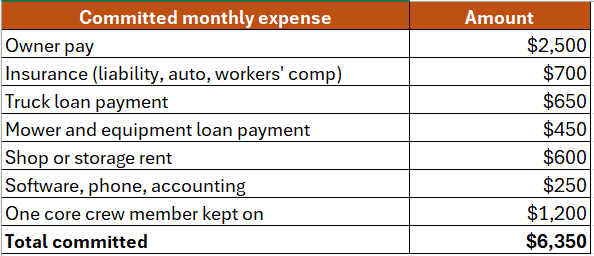
Hypothetical committed expenses: the bills that arrive whether or not the phone rings.
The two equipment payments, $1,100 a month, don't shrink when the mowers are parked. On top of that, assume fuel, salt, and supplies run about 15% of each month's billing.
Step 2: Estimate what you'll bill
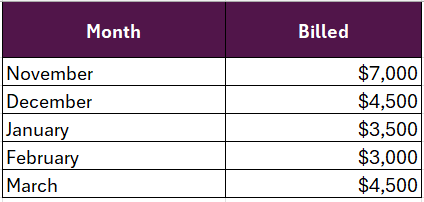
Step 3: Be realistic about collections
Billing a job is not the same as getting paid for it. In this example, 50% of each invoice is collected in the month it's billed, 40% the next month, and 10% the month after that. That means November's cash includes money from September and October's busy-season invoices, and some March invoices don't turn into cash until April and May.
Step 4: Put it together
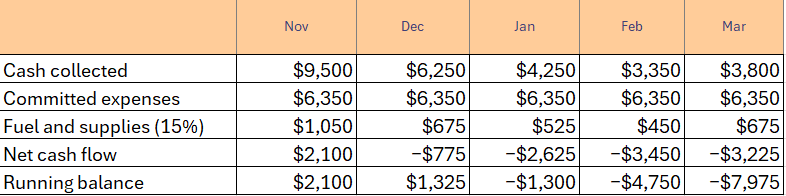
The company looks fine through December. The running balance first goes negative in January and bottoms out at about $7,975 at the end of March. That's the gap the reserve has to cover. Notice how much the November cash flatters the picture, since it's mostly fall invoices getting paid.
What Changes When Winter Work Is Uncertain
Now suppose the winter doesn't go as planned. The snow contracts don't materialize, a few customers pay slowly, and the truck needs a $1,500 repair in January. The committed expenses and the equipment payments stay exactly the same.
The downside assumptions:
November billing drops 20%, December through February drop 40%, and March drops about 30%.
Collections slow to 40% in the month billed, 40% the next month, and 20% the month after.
A one-time $1,500 repair lands in January.
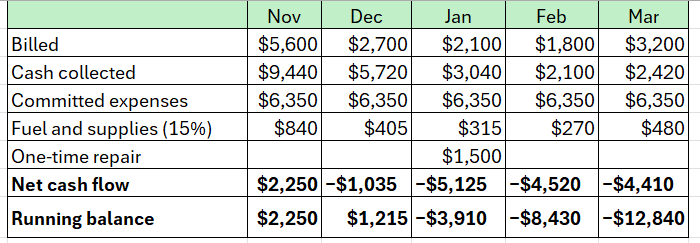
Downside: less work, slower collections, and a $1,500 repair push the low point to −$12,840.
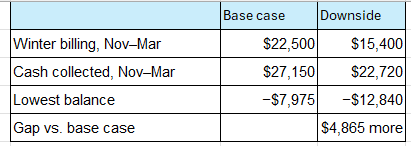
A 32% drop in billing, plus slower payers and one repair, made the shortfall about 61% larger. The fixed bills didn't move, so almost all of the lost revenue came straight out of cash.
What the downside shows you
The squeeze starts earlier. The base-case balance turned negative in January, and the downside is already close to flat in December. In both cases the cash in November and December comes from old invoices, so it can hide the problem.
Slow collections cost real money. In the downside, about $2,400 of the September and October invoices is still unpaid when December starts.
Equipment payments don't flex. The $1,100 a month doesn't care about snowfall, which is why they belong on your committed list.
Your reserve target should be the downside number. Here, that's about $13,000, not $8,000.
Set checkpoints before winter starts
Decide in advance what you'll do if the work doesn't show up. For example:
By mid-December, if snow contracts aren't signed, pause nonessential spending and reduce crew hours.
By mid-January, if the balance is below your plan, call your lender early to ask about options, and follow up on every invoice over 30 days.
Ask for deposits or prepayment on winter and early-spring jobs.
A checkpoint turns "we'll see how it goes" into a plan you can follow when you're stressed.
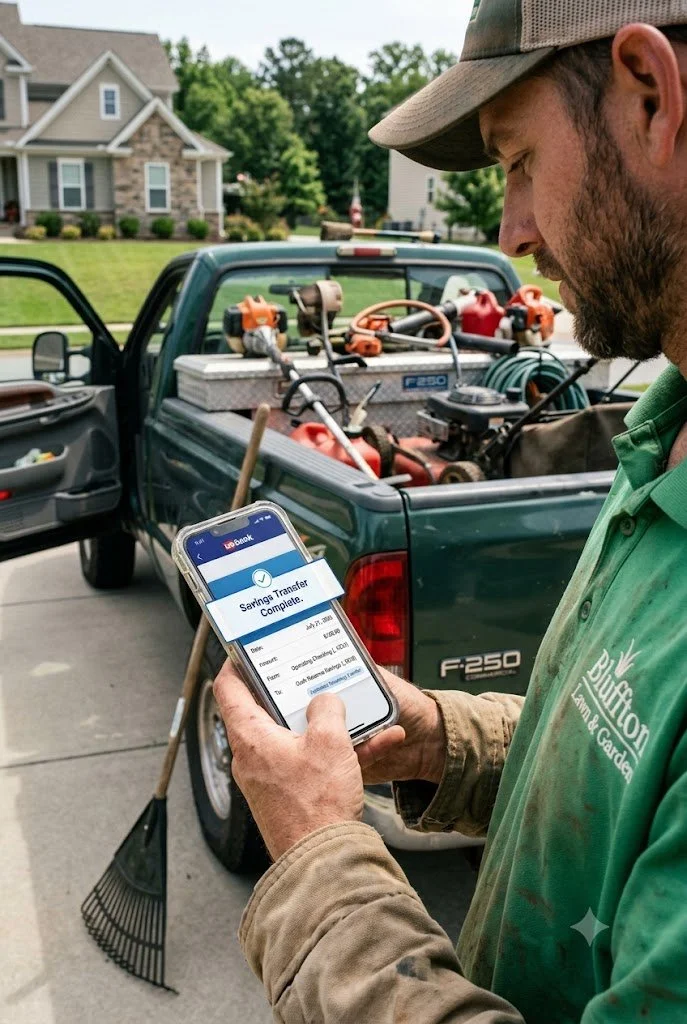
Automating your savings takes the guesswork out of building a winter cash reserve.
Make It a Habit, Not an Afterthought
The owners who handle winter well all say the same thing: they treat saving as a fixed cost, just like fuel or insurance, not something they do "if there's extra." Some set aside a flat percentage of each month's income instead of a fixed dollar amount. One owner shared: "I began setting aside about 35% of the best months into a separate account for slower periods and restocking. Winter turned out to be much less stressful.” Another owner used a smaller number, 10%, and applied it every month, not just the best ones.
Your exact percentage matters less than picking one and sticking to it. Set up an automatic transfer the same day money comes in, so you never have to decide whether to save it — it just happens.
One More Tool Worth Knowing About

Flat monthly billing spreads revenue evenly across the year instead of spiking in summer.
Some lawn care companies get ahead of this problem entirely by billing customers a flat amount every month, all year long, instead of charging more in summer and nothing in winter. One owner explained it this way: "Converting all customers to a flat monthly rate is the best advice there is. You'll actually end up being more profitable in the winter time because you are still bringing in the maintenance revenue."
This isn't the right fit for every business, and it takes some care to set up correctly on your books so you don't accidentally overstate your income. But it's worth a conversation if winter has been especially rough for you.
The Bottom Line

Planning your off-season strategy now means a calmer, more predictable winter ahead.
Winter doesn't have to be the season you dread. The businesses that get through it calmly aren't lucky — they simply looked at their slowest months ahead of time, figured out the real gap, and started saving for it while the money was still coming in.
If you'd like help figuring out your specific number, setting up a separate reserve account, or deciding whether flat monthly billing makes sense for your business, that's exactly the kind of planning we help lawn care and landscaping companies with every day.Reach out to us and let's build your off-season plan together, before the leaves start falling.