
LLC vs. S-Corp vs. Sole Proprietor: Which Business Structure Saves the Most on Taxes?
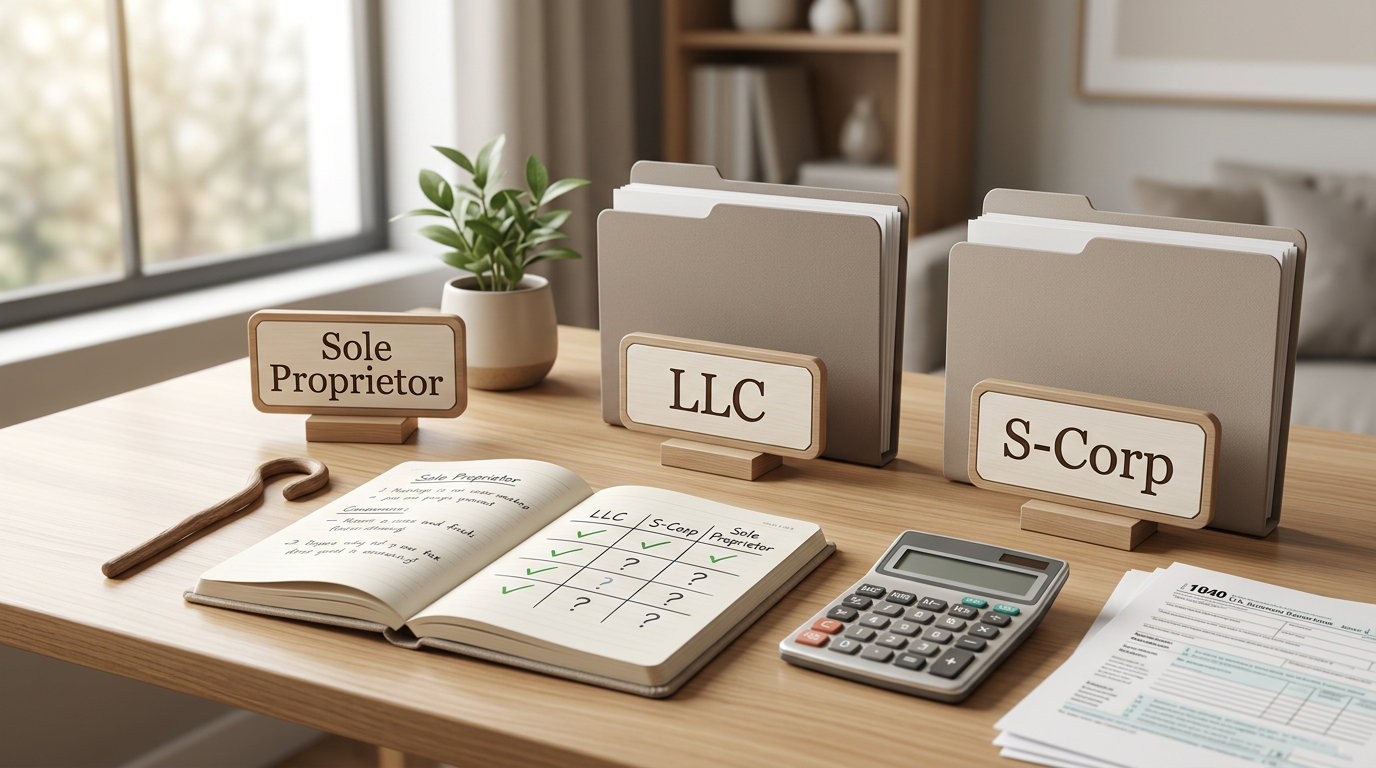
Choosing a business structure is about more than paperwork. It’s about stewardship.
If you’re self-employed, running a small business, or thinking about launching something new, one of the most important questions you can ask is this: What business structure is the most tax-efficient? The answer depends on where your business is today, how much profit it produces, and how much complexity you’re ready to manage.
For many owners, the journey starts with a sole proprietorship, moves into an LLC for protection, and eventually reaches an S-corp election for tax savings. The key is knowing when each step makes sense.
Why Your Business Structure Matters for Taxes
The way your business is set up affects how you pay taxes, how much paperwork you handle, and whether your personal assets are protected if something goes wrong.
That’s why this decision deserves more than a quick internet search or a guess based on what worked for somebody else. Wise stewardship means choosing a structure that fits your season of business — not just the one that sounds impressive.
Sole Proprietorship: The Simplest Option
A sole proprietorship is the most basic business structure. If you start earning money on your own and do not formally create a separate entity, this is usually your default setup.
There are good reasons many people begin here:
It’s easy to start.
It’s inexpensive.
Tax filing is relatively simple.
There’s very little administrative upkeep.
But simplicity comes with trade-offs.
With a sole proprietorship, all business income is reported on your personal tax return, and you generally pay both income tax and self-employment tax on the full amount of your profit. On top of that, there is no legal separation between you and the business, which means your personal assets may be more exposed.
For a side hustle or a brand-new business, this may be enough for now. But for many owners, it’s only a starting point.
LLC: Better Protection, More Flexibility
An LLC, or Limited Liability Company, is often the next wise step for a business owner who wants more protection and structure without adding too much complexity.
One of the biggest misunderstandings about LLCs is this: forming an LLC does not automatically reduce your taxes.
By default, a single-member LLC is usually taxed the same way as a sole proprietorship. That means the income still flows through to your personal tax return, and you may still owe self-employment tax on all the profit.
So why form an LLC?
It helps protect your personal assets.
It creates separation between you and the business.
It makes your business look more established.
It gives you flexibility if you later choose a different tax election.
In simple terms, an LLC is often less about immediate tax savings and more about building a healthier foundation. It puts guardrails around your business and prepares you for growth.
S-Corp: Where Tax Savings Often Begin
If your business is earning solid, consistent profit, this is where the conversation usually shifts.
An S-corp can be one of the most tax-efficient options for a small business owner, but only when the timing is right. In many cases, the owner forms an LLC first and then elects to have that LLC taxed as an S-corporation.
Why do people do that?
Because an S-corp can lower self-employment taxes.
Here’s the basic idea: instead of paying self-employment tax on all of your business profit, you pay yourself a reasonable salary through payroll. Then, if there is additional profit left over, some of it can be taken as distributions, which are not taxed the same way as earned income for self-employment tax purposes.
That structure can create real savings. But it also creates more responsibility.
With an S-corp, you typically need:
Payroll for the owner
More formal bookkeeping
Additional tax filings
Better recordkeeping
Ongoing compliance
So while the S-corp often offers the best tax efficiency, it is not always the best fit for a very small business. If the profit is not high enough, the added costs and administrative work may eat up the benefit.
Which Business Structure Is Best for Tax Efficiency?
Here’s the plain answer:
If you’re just getting started and want simplicity, a sole proprietorship may be enough for now.
If you want legal protection and room to grow, an LLC is often the best next step.
If your business has healthy, consistent profit, an LLC taxed as an S-corp is often the most tax-efficient setup.
That progression is common because it matches the life cycle of many businesses. You start simple. You add structure as you grow. Then you optimize once the numbers justify it.
That’s not just smart tax planning. That’s faithful stewardship.
When Should You Switch From LLC to S-Corp?
This is one of the most common questions business owners ask, and the answer depends on your profit, not just your revenue.
If your business is bringing in steady profit beyond what you would pay yourself as a reasonable salary, an S-corp may be worth considering. But if you are still in an early stage with inconsistent income, staying with a sole proprietorship or standard LLC may be the wiser move.
The goal is not to force a tax strategy too early. The goal is to choose the right structure for the season you’re in.
A Better Question Than “Which One Saves the Most?”
Tax savings matter. No business owner wants to give away more than necessary.
But the best question is not just, “Which structure saves the most money?” A better question is, “Which structure helps me manage this business wisely?”
Sometimes that means staying simple. Sometimes it means adding legal protection. Sometimes it means taking advantage of a more efficient tax election. Good stewardship is not about chasing every trick. It is about making calm, informed decisions that create order, protection, and margin.
Final Word
The best business structure for tax efficiency is not the same for everyone.
For some, the sole proprietorship is the right first step. For others, an LLC provides the protection they need. And for many profitable small business owners, an S-corp election becomes the best tool for lowering self-employment taxes and keeping more of what they earn.
The right choice is the one that fits your business, your income, and your season — with wisdom, not guesswork.
Call to Action
If you’re trying to decide whether your business should stay a sole proprietorship, become an LLC, or elect S-corp taxation, don’t make that decision alone.
At Accounting & Computer Concepts, we help business owners make wise, informed financial decisions with clarity and confidence. If you want help choosing the right structure for tax efficiency and long-term stewardship, contact us today and let’s talk about the next right step for your business.