
What Your Business Bank Account Is Trying to Tell You

Most business owners check their bank balance before they check their email. But checking and understanding are two very different things.
I want you to think about something you probably did this morning.
Before you checked your email. Before you looked at your calendar. Before you even finished your first cup of coffee.
You checked your bank balance.
Almost every business owner I know does it. It's one of the first things that happens every single day. A quick glance at the number — and then a decision about how the day feels.
High balance — good day.
Low balance — anxious day.
And I completely understand that instinct. The bank account feels like the pulse of the business. The most honest indicator of how things are going.
But here's what I've learned after years of sitting alongside business owners and looking at their books together:
The bank balance is not the pulse. It's a symptom. And most business owners have never been taught how to read what it's actually saying.*
Today I want to change that.
Your Bank Balance and Your Available Cash Are Not the Same Thing
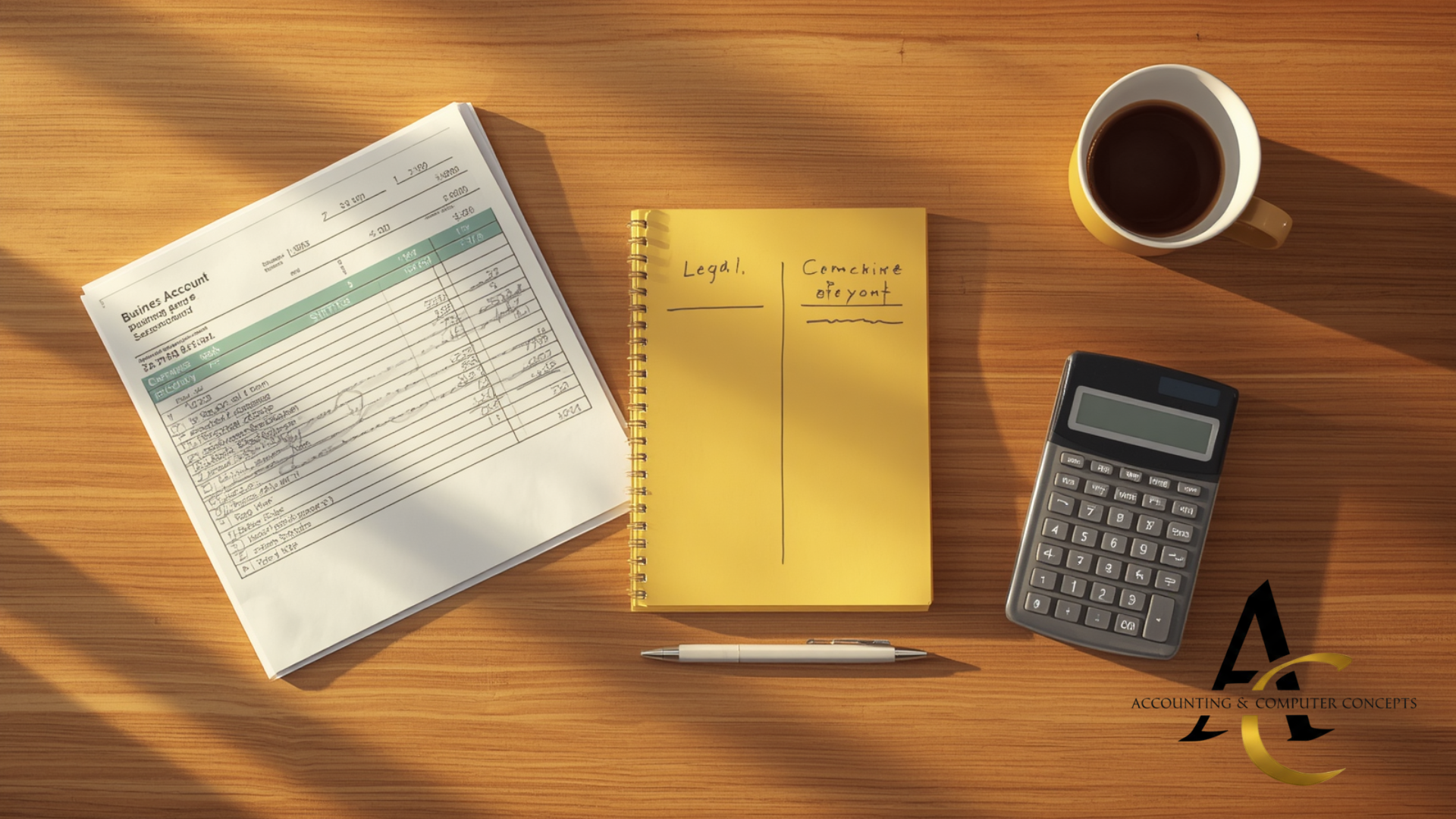
The number your bank shows you and the cash actually available to spend are rarely the same. Here's how to find the real number.
This is the first thing I want you to understand — and it surprises almost every business owner who hears it for the first time.
The number you see when you log into your bank account right now is not your available cash. Not really.
Here's why.
Sitting behind that balance are commitments you have already made. Rent that is due on the first. Payroll that processes on Friday. A vendor invoice that you approved last week and hasn't cleared yet. A quarterly tax payment that is due in eleven days. A subscription renewal that hits automatically next Tuesday.
None of those appear as deductions when you check your balance this morning. They're coming — but right now the balance looks as though the money is there.
This is what bookkeepers and financial professionals call your committed cash versus your available cash. Your committed cash is already spoken for. Your available cash — the money that is genuinely free to be used for new decisions — is almost always lower than what the bank is showing you.
Business owners who don't understand this distinction make spending decisions based on a number that doesn't reflect reality. And the consequences usually arrive about two to three weeks later — when everything that was committed comes due at once.
The first step to reading your bank account correctly is always this: before you make any spending decision, subtract every committed obligation from your current balance. That is your available cash. That is the number that matters.
What a Consistently Low Balance Is Actually Telling You

A consistently low balance is not a verdict — it's a question. The right response is curiosity, not panic.
A bank account that consistently hovers near zero — or dips into the red on a regular basis — is not just uncomfortable. It is communicating something specific. And learning to hear the message clearly is one of the most important financial skills a business owner can develop.
It may be telling you that your pricing is wrong. If your business is generating what feels like reasonable revenue but the account is consistently low, the first question to ask is whether you are actually capturing your full cost of service or delivery in your prices. Underpriced services create the feeling of being busy while quietly ensuring there is never enough margin left over.
It may be telling you that your collections are slow. You may have earned the money. It just hasn't arrived yet. Businesses that invoice on NET 30 or NET 60 terms — or that don't follow up consistently on overdue invoices — often experience a chronic low-balance situation that has nothing to do with revenue and everything to do with timing.
It may be telling you that your overhead has crept past your capacity. Expenses have a quiet way of growing faster than revenue notices. Subscriptions add up. Staffing costs rise. Overhead that made sense at one revenue level becomes a burden at a lower one. A consistently low balance is often the first sign that expenses and revenue have drifted out of alignment.
It may be telling you that you have a cash flow timing problem — not a profitability problem. This is the one that surprises business owners most. Your Profit & Loss may show healthy numbers while your bank account sits uncomfortably low — because the timing of when money comes in doesn't match the timing of when money goes out. This is not a revenue crisis. It is a cash flow management challenge. And it is solvable — but only once it's correctly identified.
A low balance is not a verdict. It is a question. And the right response is not anxiety — it is curiosity. What specifically is causing this — and what can be done about it?
What a Growing Balance Might Be Hiding

A growing balance deserves the same honest examination as a low one. Not every rising number is what it appears to be.
This one catches business owners off guard — because a growing bank balance feels like pure good news.
And sometimes it is.
But sometimes a growing bank balance is quietly concealing a problem that will surface with significant force a few months down the road.
A growing balance can mean you have uncollected tax liability building up. If you are self-employed or your business makes quarterly estimated tax payments, the money in your account may include a portion that belongs to the IRS. A bank balance that grows steadily through the year while quarterly estimated payments are skipped or underpaid is not a sign of financial health — it is a deferred obligation building toward a painful April.
A growing balance can mean you have paid a large obligation early and are holding cash you're mistaking for margin. Seasonal businesses and project-based businesses sometimes hold significant cash between major expenses — and the balance looks impressive until the next large payment is due.
A growing balance can mean you have been underinvesting in the business. Not all spending is waste. Equipment that needed replacing, marketing that could have driven growth, staffing that would have expanded capacity — a business that hoards cash while these needs go unmet is not being fiscally responsible. It is stagnating.
A growing balance can mean you are preparing for growth that requires careful management. This is the healthy version — and it looks identical on the surface to the problematic versions. The difference is intentionality. A business owner who knows exactly why the balance is growing, what it is being held for, and when it will be deployed is in a completely different position from one who is simply watching the number go up and feeling good about it.
A growing balance deserves the same honest, curious examination as a low one. Why is this growing — and do I understand exactly what this money is committed to?
Three Patterns That Predict Business Problems Six Months Early

The slow drain is the most dangerous pattern — because it never feels urgent until it is.
One of the most powerful things about learning to read your bank account correctly is this: many serious business problems are visible in the pattern of the account months before they fully arrive. Here are three patterns worth knowing.
Pattern #1: The Slow Drain
Your balance is not low. In fact, it looks reasonably healthy most of the time. But when you compare this month's average balance to last month's — and the month before — there is a quiet, consistent downward trend. Not dramatic. Not alarming on any given day. Just slowly, steadily lower.
The slow drain almost always means one of two things: revenue is slightly declining or expenses are slightly growing — and neither shift has yet been large enough to feel urgent. But left unaddressed, the slow drain becomes a cash crisis. The business owner who catches it six months early has options. The one who notices it in month eight is in a much harder position.
Pattern #2: The Feast and Famine Cycle

A growing balance deserves the same honest examination as a low one. Not every rising number is what it appears to be.
The balance swings dramatically from high to low on a regular, predictable cycle. Flush after client payments arrive. Tight — sometimes critically tight — just before the next batch of payments comes in.
This pattern almost always points to a collections timing problem or an invoicing rhythm that doesn't match the business's expense cycle. It is one of the most common patterns in service-based businesses — and one of the most fixable, once it is correctly identified. The solution is almost never "earn more money." It is almost always "change when and how you collect."
Pattern #3: The Flat Line
The balance stays essentially the same month after month — never really growing, never really shrinking. For a business that is not actively investing in growth, a flat line might feel like stability. But for most small businesses, flat is not stable. Flat is stagnant.
A flat line often means the business is covering its obligations but generating very little free cash — which means there is no reserve being built, no capacity for investment, and no buffer against an unexpected expense or revenue disruption. The business is solvent today. One bad month away from a real problem.
Why One Account for Everything Silences the Message
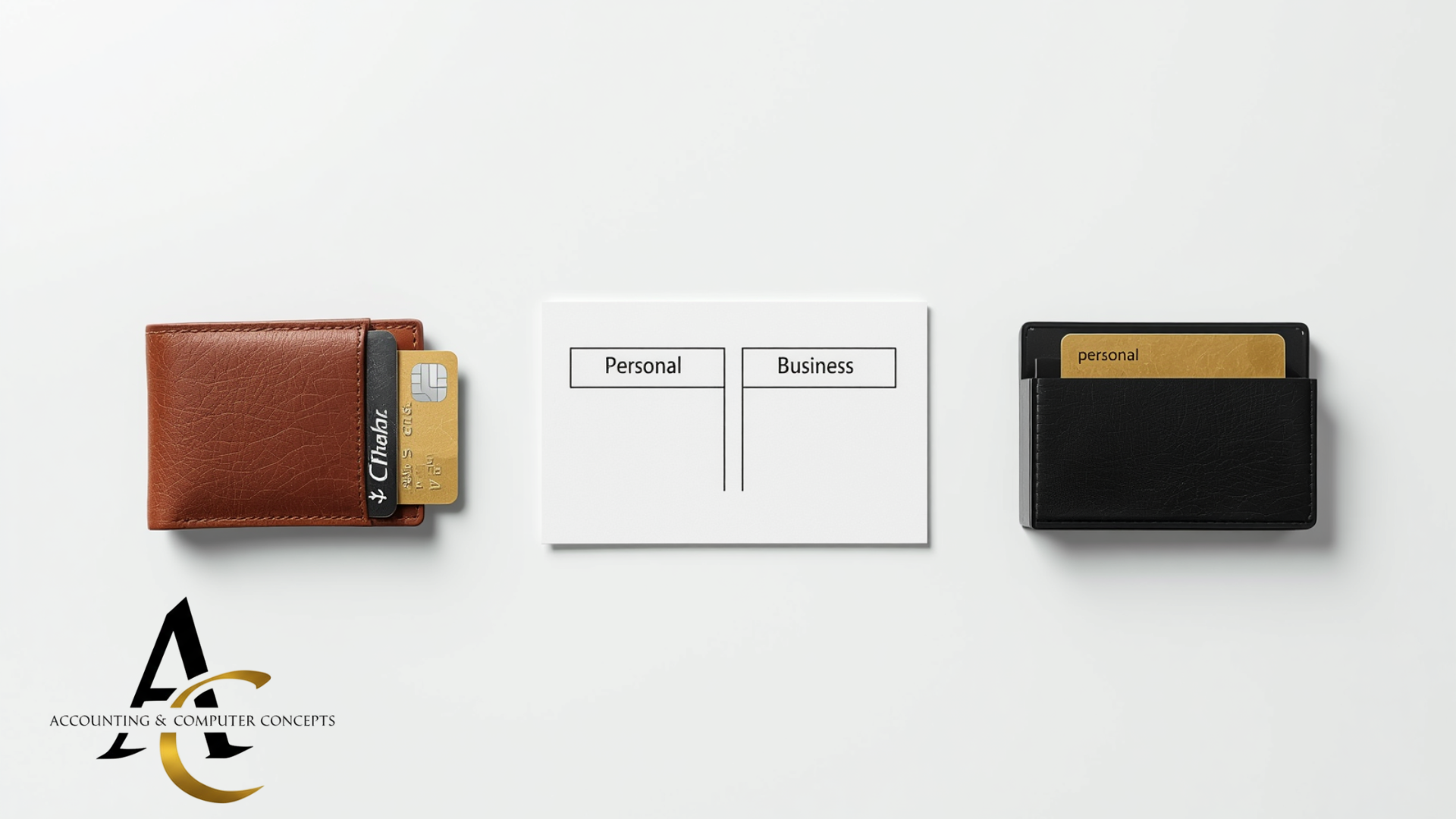
When personal and business finances share the same account, the message your business is sending you becomes impossible to read.
I want to close with something I tell almost every new client I sit down with — because it is the single most important structural change a business owner can make to improve their financial clarity.
If your business income, your business expenses, your personal income, and your personal expenses all run through the same account — the message your bank account is trying to send you is completely incoherent.
You cannot read a message written in three languages simultaneously. And a mixed account is exactly that — a tangle of business signals and personal noise that makes it nearly impossible to know what the business is actually doing.
Separate accounts are not just a bookkeeping best practice. They are the foundation of financial clarity. When your business account contains only business transactions, every pattern becomes readable. Every trend becomes visible. Every signal becomes actionable.
The business owner with a dedicated business account and clean, current books can look at their bank account in the morning and actually understand what they are seeing — not just how much, but why, and what it means for the decisions ahead.
That is the kind of financial clarity that changes how you lead your business. And it is available to every business owner willing to make the structural changes that allow it.

You don't have to decode your numbers alone. That's exactly what we're here for.
At Accounting & Computer Concepts, we help business owners decode exactly what their numbers are saying — and build the financial systems that make those messages clear every single month.
You don't have to keep guessing at what your bank account is telling you.
👉Let's decode your numbers together — schedule a free consultation today.