

Get your vendor file in order before the holidays.
Here's my honest opinion: a tidy vendor file is the cheapest year-end fix there is. It costs you an afternoon now or a miserable week in January. Gather and clean up your vendor records today, so you're not chasing paperwork when everyone else is too.
One boundary before we start. This post is about getting your records ready, not about deciding who gets a 1099. That decision belongs at the end, with your tax preparer, once the file is complete.

The 1099-NEC deadline is February 1, 2027.
Why Preparation Comes First
The 1099-NEC for 2026 payments is due February 1, 2027, because January 31 falls on a Sunday. From today, that's about 12 weeks away, and only about 7 weeks remain in the year. That sounds like plenty of time. It isn't. Vendors take days or weeks to return paperwork, and the holidays slow everyone down, so start now.
Preparing records and deciding who needs a form are two different jobs, and I'd keep them apart. Right now, you only need to know who you paid, how you paid them, and whether the information on file is complete. Reading the rules on who gets a form comes after that. People who skip ahead to the rules tend to stall on the first confusing vendor, and the file never gets built.
The Records Checklist
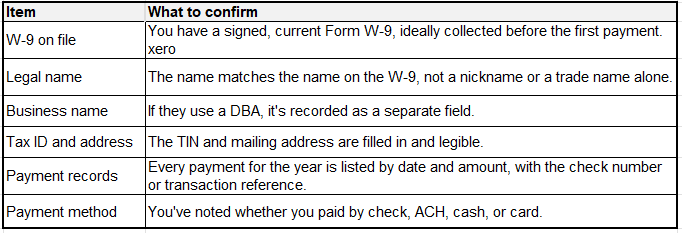
For each vendor you paid this year, check these six items:
Why the legal name matters
This one gets overlooked more than anything else. The name on your 1099 should match the name the IRS has for that taxpayer. A vendor in your books as "Mike's Fencing" may have a W-9 under "Michael R. Jones." Record both, and use the legal name on tax forms. Your books can keep the friendly name, and honestly, they should.

Use the legal name on the W-9, not the nickname.
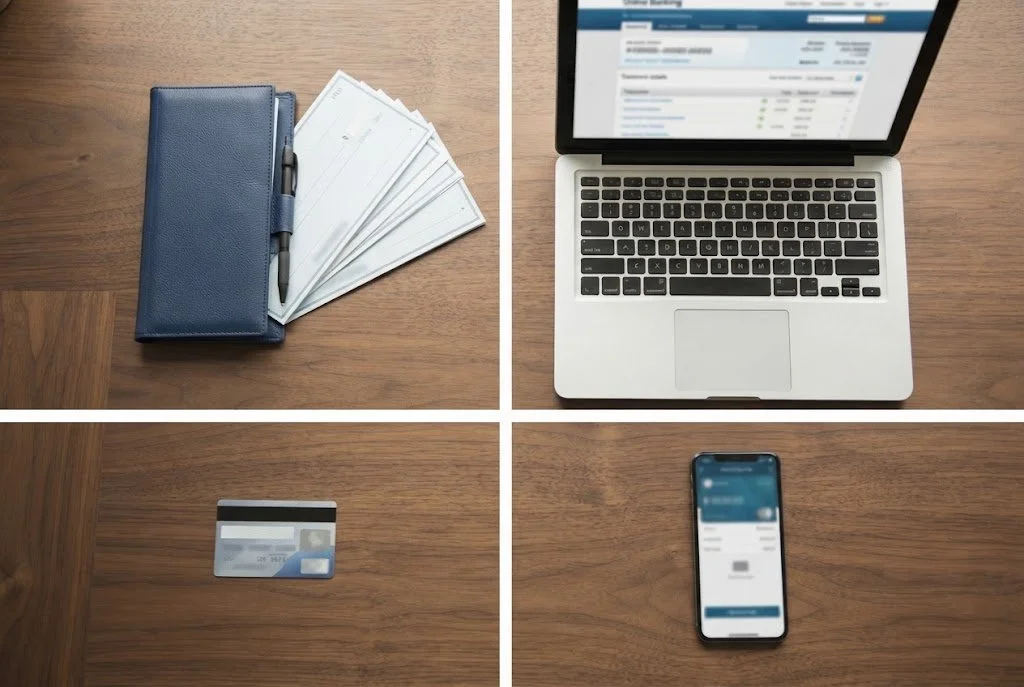
Track how you paid each vendor. Card payments are reported differently.
Why payment method matters
Payments made by credit card or through a third-party network, such as PayPal or a payment app, are reported by the payment company on Form 1099-K. The payer doesn't report them on Form 1099-NEC. So keep card payments separate from checks and ACH payments in your records. The IRS instructions explain this, and your preparer will confirm how it applies to you.
A Step-by-Step Workflow
Pull a vendor payment report. In QuickBooks Online, run a report of expenses by vendor for January 1 through today. Export it to a spreadsheet.
Add the checklist columns. Add columns for W-9 received, legal name, TIN on file, address, and payment method.
Mark what's missing. Highlight every blank. Don't fix anything yet.
Sort by total paid. Start with the largest vendors, since they're more likely to matter.
Request missing W-9s. Send a short, friendly request with a blank W-9 attached. Keep a note of the date you asked.
Match names. Compare each W-9 name with your vendor list and fix mismatches.
Split payments by method. Mark which payments went through a card or payment app.
Hand off the file. Give the completed list to your tax preparer for a determination.
And don't wait for a perfect file. I'd take a file with a few clearly marked gaps over a perfect one that doesn't exist. Gaps you can see are gaps you can fix.
What to Say When You Ask for a W-9
Keep it simple. Nobody wants a long email about tax forms.
"Hi [Name], we're updating our vendor records for year-end. Could you fill out the attached W-9 and send it back by [date]? Thanks for your help."
If a vendor won't provide a TIN, the payer may be required to withhold 24% from future payments, under backup withholding rules. That's a serious step, so check with your preparer before you act on it.
The Final Decision: Who Needs a Form
The checklist gets your records ready. It doesn't decide who gets a form, and I don't want you to treat it as if it does.
For payments made in 2026, the general reporting threshold for Forms 1099-NEC and 1099-MISC is $2,000, up from $600. The threshold applies to total payments to a payee across the calendar year, not to a single invoice. Whether a particular payment counts depends on the type of payment, the vendor's entity type, and the payment method. That's more moving parts than a blog post can settle for your business.
Tax rules change, so rely on current IRS guidance and your preparer for the final call. Sort the file first, then decide.
Timeline
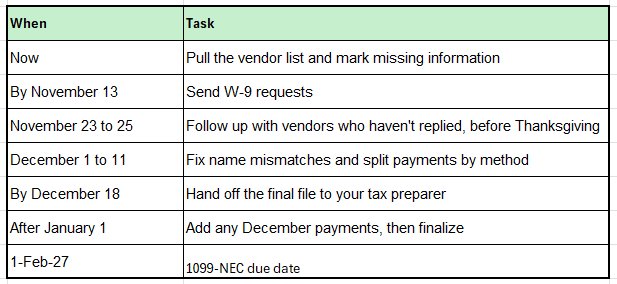

Prepare the records first, then let your preparer decide who gets a 1099.
Want Help Getting Your Vendor File Ready?
If your vendor records are scattered across email, texts, and receipts, you're not alone, and it helps to have someone sort them. On a free 30-minute Game Plan Call, we'll look at where your vendor records stand and map out what to gather before January.
Book a Game Plan Call
This article is for education only and isn't tax or legal advice. Confirm reporting requirements with your tax professional.