

A $25 wage rarely means a $25 cost.
Let me save you some pain: an employee paid $25 an hour costs you closer to $40 for every hour they spend on billable work. If you've been bidding jobs at the wage, you've been giving money away. Here's the math, step by step, so you can run it with your own numbers.
New to job costing? Start with :
This post covers one piece of it, and it's the piece I think owners skip most often: turning an hourly wage into a real labor cost.
Every Number Here Is an Example
I'm using made-up figures. Your health plan, workers' comp rate, and time-off policy won't match mine, so swap in your own as you go. Please don't copy my numbers into your bids. That would be the opposite of the point.
Our example is a full-time employee at $25.00 an hour, paid for 2,080 hours a year (40 hours × 52 weeks).
Step 1: Start With Wages, Then Add Employer Costs
Annual wages are $25.00 × 2,080 = $52,000. That number is only the starting point. Everything the employer pays on top of it is the part that catches people.
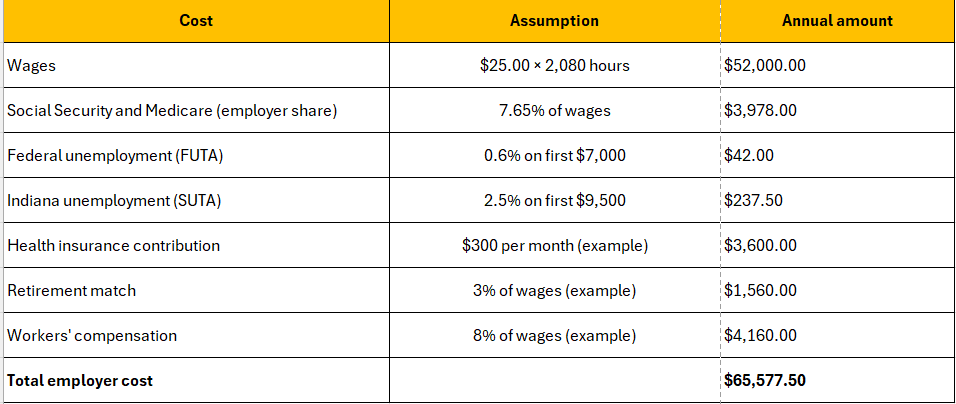
Illustrative annual cost of one $25-per-hour employee. Your rates will differ.
A quick word on where the tax numbers come from. The employer share of Social Security and Medicare is 7.65%, which is 6.2% plus 1.45%. FUTA is 6.0% on the first $7,000 of wages, but most employers who pay state unemployment on time get a credit that brings it to 0.6%, about $42 per employee. Indiana's new-employer rate is 2.5% on the first $9,500. Your own rate may be different once your account has some history.
The health, retirement, and workers' comp lines are placeholders. Workers' comp swings a lot by trade, so use the rate on your policy, not mine.
Add it all up and the extra cost on top of wages is $13,577.50, about 26% of wages. Already, on paper, your $25 employee costs $31.53 per paid hour ($65,577.50 ÷ 2,080). Most owners stop here and feel pretty good about being thorough. Don't stop here.
Step 2: Paid Hours Are Not Working Hours
You pay for holidays, vacation, and sick days, and nobody is on the job for them. I'm not arguing with paid time off. It's good business, and I'd keep it. I'm only saying it has to be in the number.
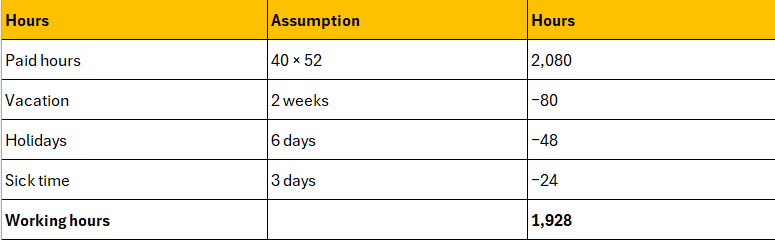
Illustrative example: 2,080 paid hours become 1,928 working hours.
You still pay the full $65,577.50, but you get 1,928 working hours for it. That makes the cost per working hour $65,577.50 ÷ 1,928 = $34.01. We're up nearly $9 over the wage, and we're not done.
Step 3: Working Hours Are Not Productive Hours

Not every working hour goes to a customer's job.
This is the step that hurts. Even on a day when everybody shows up, not every hour goes to a customer's job. Shop cleanup, driving between sites, loading the truck, safety talks, and waiting on materials are all real time, and nobody pays for them directly. I'd call that the quiet cost of running a crew.
For this example, I'm assuming 85% of working hours go to jobs. That's a guess, and your real number could be better or worse. Pull your time records and find out. Honestly, most owners are surprised in one direction or the other.
Productive hours: 1,928 × 0.85 = 1,638.8
Cost per productive hour: $65,577.50 ÷ 1,638.8 = $40.02
The $25 wage is really a $40.02 cost per productive hour, about 1.6 times what you see on the paycheck.
Step 4: How This Changes Your Job Estimates

Use your true hourly cost in every estimate.
Say you estimate a job at 120 labor hours.
Using the wage only: 120 × $25.00 = $3,000
Using the productive-hour cost: 120 × $40.02 = $4,802
The wage-only estimate leaves out about $1,800 of real cost. On a job priced with a thin margin, that gap can wipe out your profit, and you won't know why until the job is over.
One caution, because I don't want you to overcorrect. This number is still only cost. It doesn't include overhead such as truck insurance, software, the office, or your own time, and it doesn't include profit. Those get added after you know your true labor cost. Think of this number as the floor under your bid, not the price.
Find Your Own Number
Here's the quick version:
Write down the hourly wage.
Add up annual taxes, benefits, and insurance, then add them to annual wages.
Subtract paid time off from paid hours to get working hours.
Estimate the share of working hours that go to jobs.
Divide total annual cost by productive hours.
It takes about twenty minutes the first time. If your numbers don't look like mine, that's fine. They aren't supposed to. What matters is that you've run them at all.
Want Help Running Your Numbers?
If you'd like to run this calculation for your own crew, book a free 30-minute Game Plan Call. We'll go over your wages, your insurance, and your time records, and set a labor rate you can use in your next estimate.