
Sales Tax for Small Business: What You Don't Know Can Cost You

Sales tax surprises don't wait for a convenient time — and neither do state auditors.
You're running a lean business. You're watching every dollar. But there's a compliance area that could quietly unravel everything — and most small business owners have no idea they're exposed.
Sales tax is the most misunderstood and most aggressively enforced compliance area for small businesses in America. And since 2018, the rules changed in a way that affects nearly every business that sells anything — products or services — whether you operate a storefront in one town or sell online to customers across the country.
If you haven't reviewed your sales tax obligations recently, keep reading. This could be the most important 5-minute read your business gets this year.
The Rule That Changed Everything: South Dakota v. Wayfair

One Supreme Court decision in 2018 rewrote the rules for every business that sells across state lines.
Before June 21, 2018, states could only require you to collect sales tax if you had a physical presence there — a store, a warehouse, an employee. That all changed when the U.S. Supreme Court ruled in South Dakota v. Wayfair, Inc., overturning the old physical presence standard and replacing it with something called economic nexus.
The result? Every state with a sales tax immediately passed laws requiring remote sellers to collect and remit sales tax based solely on their sales activity. You don't have to set foot in a state to owe it taxes anymore.
What Is Economic Nexus — And Why Should You Care?
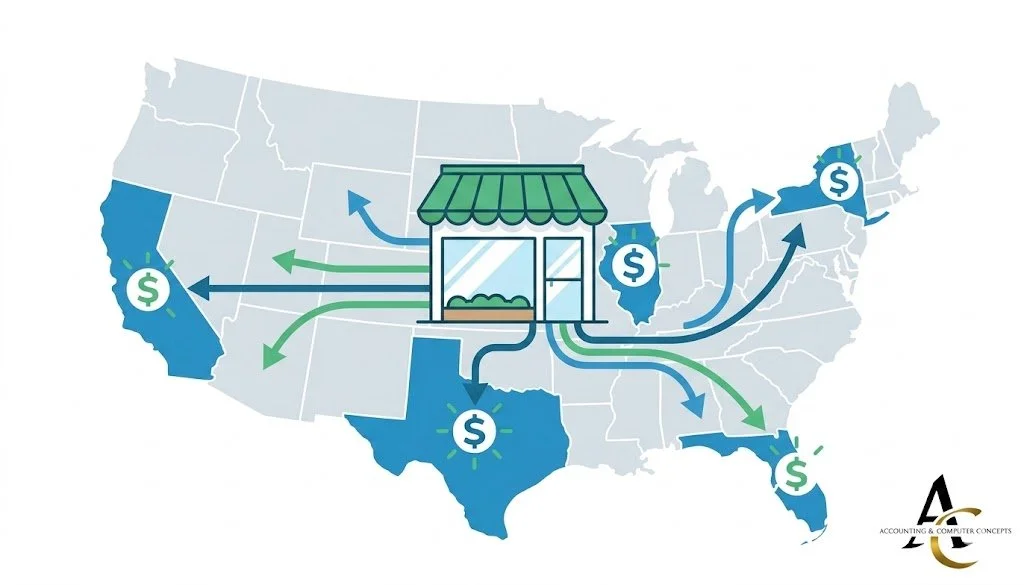
You don't have to leave your state to owe taxes in another one — that's exactly what economic nexus means.
Economic nexus means that if your sales into a state exceed a certain threshold, you are legally obligated to collect and remit sales tax there — even if you've never driven through it.
Here's what most small business owners don't realize:
The most common threshold is $100,000 in annual sales or 200+ transactions into a state. If you sell on Etsy, Shopify, Amazon, or even your own website, you could cross this threshold without realizing it.
Thresholds vary by state. California, for example, requires $500,000 in sales before economic nexus kicks in. Most other states are far more aggressive at $100,000.
Illinois removed its 200-transaction threshold as of January 1, 2026, meaning economic nexus is now triggered purely by $100,000 in gross receipts.
Once you cross the threshold, you must register, collect, and remit — immediately. Most states apply this prospectively, but some may require retroactive collection on the very sales that created the obligation.
Economic nexus doesn't care about your size. It cares about your activity.
Products vs. Services: The Taxability Trap
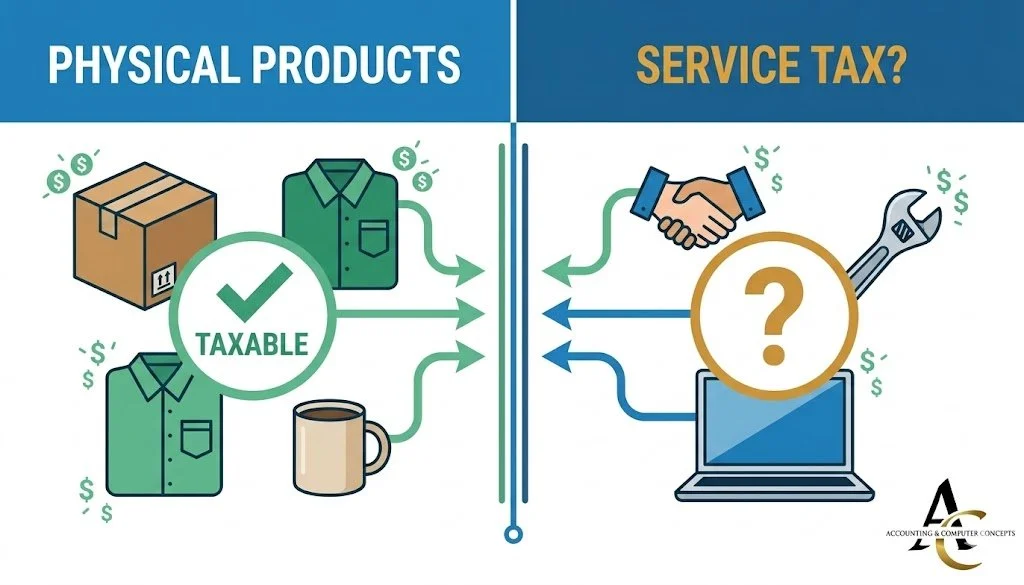
What you sell matters — but so does which state your customer is in when they buy it.
Here's where it gets genuinely complicated. Not everything you sell is taxable — and the rules are different in every state.
Tangible products (goods, merchandise, physical items) are taxable in most states, but even here there are exemptions for things like groceries, clothing, and agricultural items — depending on where you are.
Services are a patchwork nightmare. Some states tax almost no services. Others tax specific services like digital services, consulting, landscaping, or cleaning. A few states tax nearly everything.
Digital products and SaaS (software-as-a-service) are an especially gray area, with states rapidly updating their rules to capture these revenue streams.
The bottom line: You cannot assume your product or service is tax-exempt just because it "feels" like it should be. You need to verify taxability state by state.
The Most Common Sales Tax Mistakes — And What They Cost
These are the errors I see most frequently — and every one of them carries real financial consequences:
An audit notice is not the way you want to find out you had a sales tax obligation.
Not registering in states where you have economic nexus. You cross the $100,000 threshold in a new state and keep selling without registering. The state eventually audits you and hits you with back taxes, interest, and penalties for every month you were non-compliant.
Charging the wrong tax rate. Sales tax rates are hyper-local — state, county, and city rates stack on top of each other. Charging the wrong rate means you either owe the difference or have to refund customers.
Failing to collect exemption certificates. If you sell to a wholesale buyer or tax-exempt organization and can't produce a valid exemption certificate during an audit, you owe the tax — not the customer.
Ignoring marketplace facilitator rules. If you sell through Amazon or Etsy, those platforms collect and remit sales tax on your behalf in most states. But not all. Assuming they've covered everything can leave gaps.
Missing filing deadlines. Penalties for late filing accrue monthly as a percentage of unpaid taxes. Interest accrues daily. A small oversight compounds fast.
The consequences range from interest and failure-to-file penalties to civil lawsuits initiated by state tax authorities — and in extreme cases of persistent non-compliance, criminal charges.
How to Register, Collect, and Remit Correctly in 2026
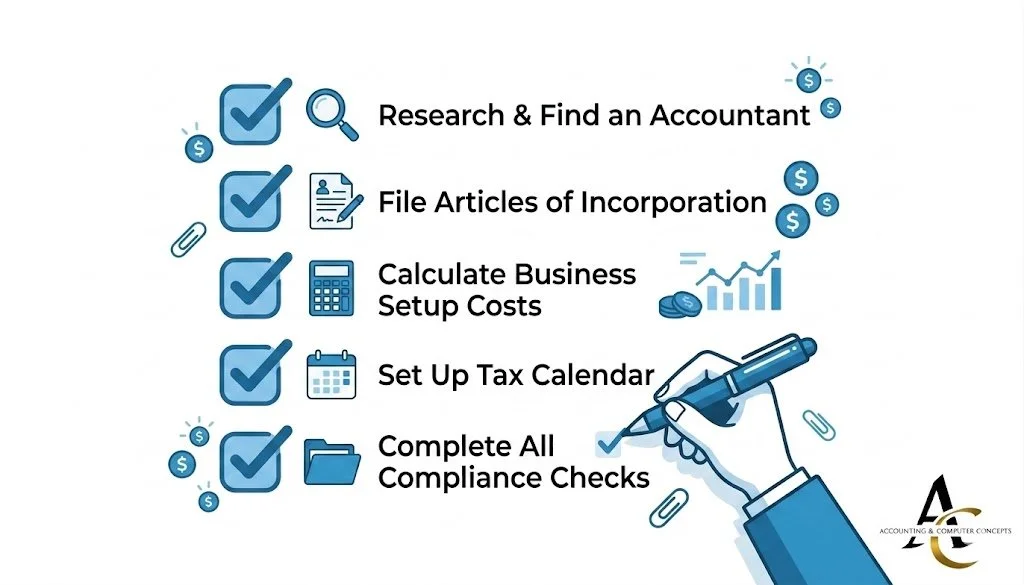
Compliance isn't complicated when you know the steps — and take them in the right order.
The compliance process is straightforward once you know you have an obligation:
Audit your sales data. Review the last 12 months of sales by state. Identify any state where you've crossed the $100,000 threshold (or applicable state-specific threshold).
Register for a sales tax permit in every state where you have nexus — before your next taxable sale in that state.
Configure your point-of-sale or e-commerce platform to charge the correct tax rate for each customer's location.
File returns and remit on time. Each state has its own filing frequency (monthly, quarterly, or annually based on your sales volume). Missing a deadline triggers penalties immediately.
Document exemptions. Collect and store valid exemption certificates from any customer claiming tax-exempt status.
Tools like Avalara, TaxJar, and TaxCloud can automate much of this — but you still need a professional to verify your nexus footprint and catch what the software misses.
What to Do If You're Already Non-Compliant

Discovering you're behind on sales tax isn't the end — but waiting to address it could be.
First — don't panic. You're not alone, and there are legitimate paths forward.
Assess the full scope of your exposure. Identify every state where you may have had nexus, and for how long.
Look into Voluntary Disclosure Agreements (VDAs). Most states offer programs that allow businesses to come forward voluntarily, often resulting in waived penalties and a limited lookback period. This is almost always better than waiting to be audited.
Consult a tax professional before contacting any state. Once a state flags your account, your negotiating leverage drops significantly.
File overdue returns and arrange payment. If you owe back taxes, many states will work with you on a payment plan.
The worst thing you can do is know you have a problem and do nothing. States have become increasingly aggressive at identifying non-compliant sellers through third-party data — including marketplace sales data.
The Bottom Line

Getting compliant is easier when you don't have to figure it out alone.
Sales tax compliance isn't optional, and the "I didn't know" defense doesn't hold up in an audit. Whether you sell handmade products on Etsy, run a service-based business with clients in multiple states, or operate a local storefront with growing online sales — your obligations deserve a serious, professional look.
📌 Not sure where you stand? That's exactly what we're here for.
Let's sit down together, review your sales footprint, and make sure every state where you have an obligation is handled correctly — before someone else finds it first.