

The "small extra" rarely feels expensive in the moment.
I'll say it plainly: most contractors don't lose money on the big mistakes. They lose it on the favors. A customer asks for one small extra, you say yes because it's easy and it keeps them happy, and the job's margin takes a hit nobody records.
I'm not telling you to be stingy. Being generous is part of why people hire you. But generosity you can't see in your books is just a leak, so let's follow one small extra from the first request to the last payment.
The Hypothetical Job
Everything here is made up, so don't treat the numbers as benchmarks. A remodeling contractor sells a job for $40,000. The estimate shows $32,000 of cost, so planned profit is $8,000, or 20% of the price. That's a 25% markup on cost ($32,000 × 1.25 = $40,000).
For labor, I'm using a loaded cost of $40 an hour, which comes from https://www.acconcepts.info/small-business-bookkeeping-blog-accounting-computer-concepts/what-one-employee-really-costs-per-hour-a-calculation-you-can-follow.
One Small Extra, Start to Finish
On day six, the homeowner says, "Can you add an outlet on the back wall while you're here? Should be quick."

The request
This is where the money is won or lost, and it takes about five seconds. Pause. Something like "good idea, let me write that up so you can see the cost" is all it takes. I know it feels awkward. It's much less awkward than the conversation at the end of the job.
Pricing it
Price the real cost, not the part you can see from the doorway:
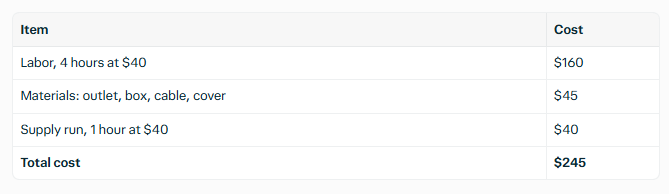
Nobody remembers the supply run, but somebody pays for it. Use the same markup as the original contract: $245 × 1.25 = $306.25, which I'd round to $310. That leaves about $65 of profit. Mention any schedule impact too, since a small change can still cost you a day.
Written approval
No signature, no work. For something this small, a text or email with a date is enough: "Approved, $310, adds one day." That's all you need for a change like this one. The size of the change decides how formal to get. One common rule of thumb is to log anything under $100, get a written yes for $100 to $500, and use a full change order above that. I'd treat those cutoffs as a starting point, not a law, and check your contract and state rules.

Tag every change so you can see where the cost went.
Capturing the cost
This is where I see books fall apart, and it's the least glamorous step. The hours and the receipt have to land on the job and carry a tag for the change, such as "CO-001." If they don't, the cost vanishes into the original job and looks like an overrun, and you never find out that the extras were the cause. In QuickBooks Online, that means:
Coding the receipt to the job, with the change number in the memo
Entering crew time against the same job
Raising the running contract total to $40,310
Billing it
Put the change on your next regular invoice. Waiting until the final invoice is a mistake, because by then everyone has forgotten the conversation. Reference the approval on the invoice line so the customer sees a number they already agreed to.
Collecting
If the approval is in writing, the line gets paid with the rest of the invoice. If it isn't, you're in a debate about what someone remembers saying. Without written authorization, you risk not being paid at all.
Now Make It Five
Small extras show up in bunches. Here's the same job with five of them, all hypothetical:
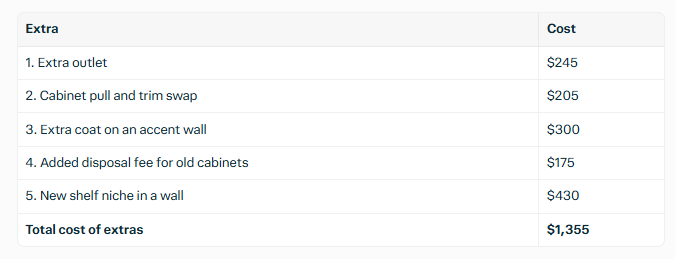
That's 22 crew hours and $475 in materials and fees. Do all five for free and your profit drops from $8,000 to $6,645, and your margin from 20% to about 16.6%. You lost almost 17% of the planned profit and never sent a bad invoice. Nothing felt like a mistake at the time, which is exactly what bothers me about it.
Three Ways This Job Could End
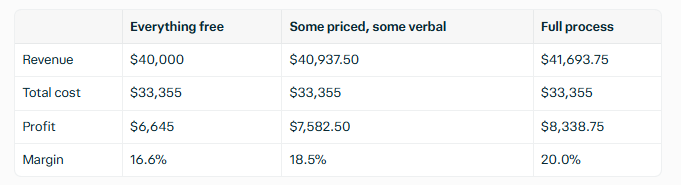
Hypothetical example: the same job ends at a 16.6%, 18.5%, or 20.0% margin, depending on how extras are handled.
In the middle column, three extras were approved in writing and billed. The other two were priced out loud, and the customer wouldn't pay for them at the end, so they got written off. In the last column, all five were approved, billed, and collected at the original markup.
The gap between the first and last columns is $1,693.75 on a $40,000 job. Every dollar of it came from work you already did. I'd be annoyed about that, honestly.
What I'd Do About It
Tag every change. If you can't see change-order costs, you can't manage them. One label, used the same way every time.
Track the running contract total. Original contract plus approved changes is the number your job report should compare against cost.
Bill the change on the next invoice. Don't save it for the end.
Pick a free-favor rule. I'm all for a small favor, but pick the size ahead of time. Twenty free $150 favors can wipe out half the profit on a $30,000 job at a 20% margin.
Read your contract. Some require written approval before extra work, and some have notice deadlines that can cost you the right to be paid.
Fair warning: even with all this, you'll still say yes to some things for free, and that's fine. Just make it a choice you can see.
Want a Second Set of Eyes on Your Jobs?
If you're not sure what your extras have cost you, we can look at a recent job together. On a free 30-minute Game Plan Call, we'll review how changes are priced, approved, and recorded in your books, and set up a simple process for the next job.
All figures are hypothetical and for education only. This isn't legal or tax advice. Check your contracts and state requirements with a qualified professional.