
How to Read a Cash Flow Statement Without an Accounting Degree
I want to tell you about two business owners I know.
Both had a good year. Revenue was up. Customers were happy. By every visible measure, things were going well.
But one of them came into December confident, clear-eyed, and ready for what was next. The other came in panicked — because there was almost nothing left in the bank, and he couldn't explain why.
Same kind of business. Similar revenue. Completely different financial reality.
The difference between them came down to one thing: one of them understood his cash flow statement, and one of them didn't.
Today, I want to change that for you.
First, Let's Clear Something Up

Most business owners have heard of three financial statements: the Profit & Loss (P&L), the Balance Sheet, and the Cash Flow Statement. If you're like most people, you might glance at the P&L occasionally and hand everything else to your accountant.
But here's what I want you to understand: your P&L tells you whether your business is profitable. Your Cash Flow Statement tells you whether your business is alive.
Those are two very different questions — and confusing them is one of the most dangerous financial mistakes a business owner can make.
What Is a Cash Flow Statement, Really?
In plain language, your Cash Flow Statement is a record of every dollar that actually moved — into your business and out of it — during a specific period of time.
Not money you earned. Not money you're owed. Money that actually arrived in your bank account, and money that actually left it.
Think of it this way: your P&L is like a scoreboard. It tells you whether you won the game. Your Cash Flow Statement is like the game film — it shows you every single play, in real time, that got you to that score. And sometimes the film reveals things the scoreboard completely hid.
The Three Sections — And What Each One Means

Your Cash Flow Statement is divided into three sections. Each one tells a different part of the story.
Section 1: Cash Flow from Operating Activities
This is the most important number on the entire statement. It shows the cash your business generated — or consumed — from its day-to-day operations. Collecting payments from customers. Paying vendors and employees. Covering taxes and interest.
A positive number here means your business is generating real cash from what it actually does. That's the foundation of a healthy business. A negative number means your core operations are consuming more cash than they're producing — and that is a signal that deserves serious attention, regardless of what your P&L shows.
Section 2: Cash Flow from Investing Activities
This section tracks cash spent on or received from assets and investments — purchasing equipment, buying property, selling a vehicle, or investing in another business.
A negative number here is not automatically bad. In fact, for a growing business, it often means you're investing in your future — buying tools, equipment, or infrastructure that will generate returns over time. The question to ask is: are these investments strategic and sustainable?
Section 3: Cash Flow from Financing Activities
This section shows the movement of cash related to how you fund your business — loan proceeds, loan repayments, owner contributions, and owner draws or distributions.
If your business is consistently relying on financing activities to stay cash positive, that's a flag. It means operations alone aren't sustaining the business — you're borrowing to survive, not to grow.
The Most Important Lesson: Profit ≠ Cash
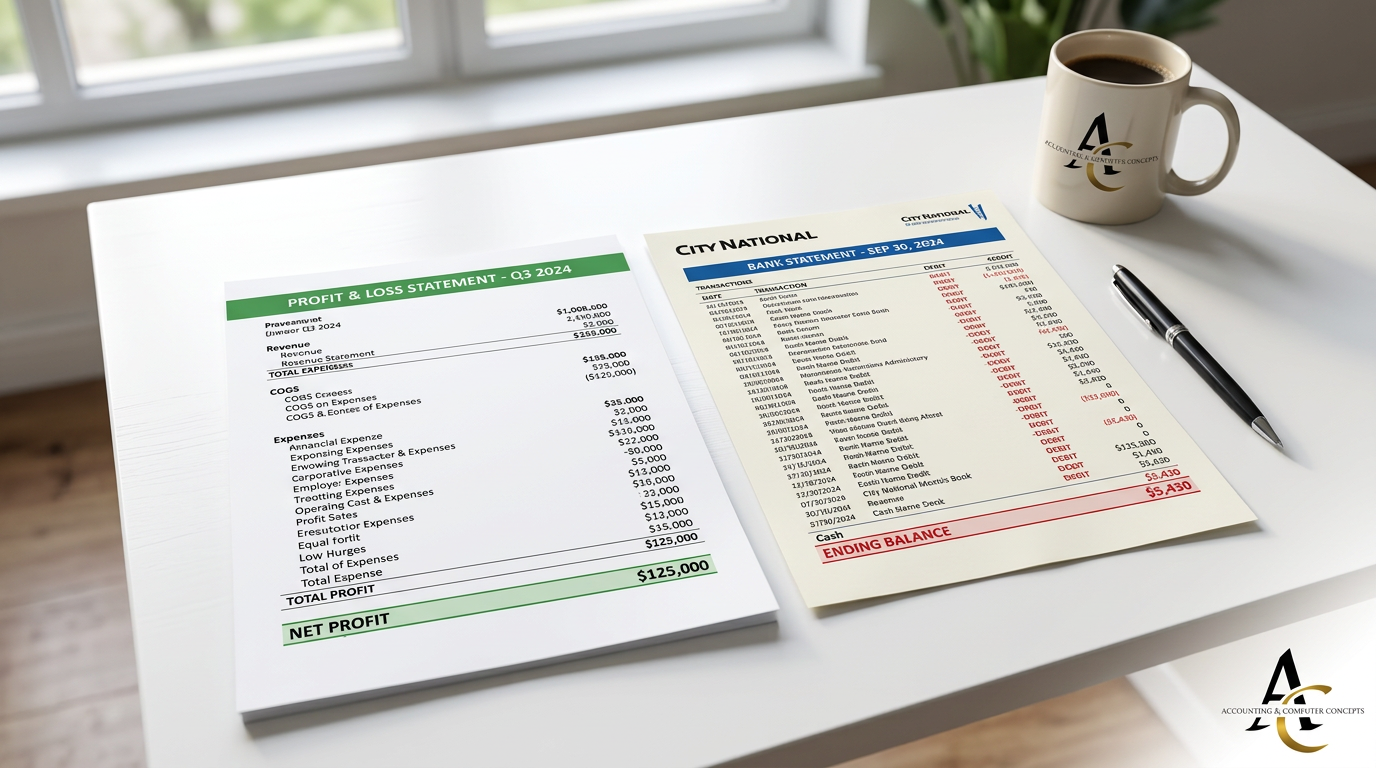
Let me show you something that surprises almost every business owner the first time they see it.
Imagine you invoice a client for $20,000 in November. On your P&L, that shows up as $20,000 in revenue — your business looks profitable. But that client doesn't pay until January. So in November, your Cash Flow Statement shows zero dollars received from that client.
Meanwhile, your employees still need to be paid. Your rent is still due. Your vendors aren't waiting.
Your P&L said you made money. Your Cash Flow Statement told the truth about your bank account.
This gap — between what you've earned and what you've actually received — is why businesses that look profitable on paper can run completely out of cash. It's one of the primary reasons small businesses fail, not from lack of revenue, but from lack of cash timing.
Four Questions to Ask Every Month
You don't need a finance degree to get value from your Cash Flow Statement. You just need to ask four questions consistently:
Is my operating cash flow positive? If the answer is yes, your business is sustaining itself from its own operations. If no — find out why before it becomes a crisis.
Am I collecting receivables fast enough? Long gaps between invoicing and payment are one of the most common causes of cash flow problems. Review your accounts receivable aging regularly.
Are my investing activities intentional? Every dollar spent on assets should be a strategic decision — not an impulse purchase that quietly drains your cash reserves.
Am I relying on financing to cover operations? Taking out loans to grow is smart. Taking out loans to make payroll is a warning sign that something deeper needs to be addressed.
Free Cash Flow — The Number That Changes Everything
Once you understand the three sections, there is one additional number worth calculating every month. It's called Free Cash Flow, and it is arguably the single most telling metric in your entire business:
Free Cash Flow = Operating Cash Flow − Capital Expenditures
Free Cash Flow is what's left after your business has covered its operations and made the investments needed to maintain and grow. It's the money that is truly, freely yours — available to pay down debt, build a cash reserve, invest in marketing, or take home as the fruit of your hard work.
A business with consistently positive Free Cash Flow is a business that is genuinely healthy — not just on paper, but in reality. That's the goal. That's what we want to help you build toward.
Your Numbers Are Telling You a Story

The Cash Flow Statement is not a document for accountants. It is a window into the actual financial heartbeat of the business you've poured your life into.
Every number on that statement represents a decision, a client, a purchase, a delay, or an opportunity. When you learn to read it — even at a basic level — you stop leading your business by gut feeling and start leading it with genuine clarity.
And clarity, in my experience, is one of the greatest gifts you can give yourself as a business owner. It replaces anxiety with understanding. It turns reactive decisions into intentional ones. And it means that you're never again blindsided by a bank account that doesn't match what you thought the business was doing.
You don't have to figure this out alone. We make the numbers simple. We'll walk you through your Cash Flow Statement in plain English, show you what it's actually telling you about your business, and help you build the financial clarity to lead with confidence.
If today's post resonated with you, I want to make it easy to take the next step. I've created the Cash Flow Clarity Kit specifically for small business owners who are tired of feeling like the numbers don't add up — because they deserve tools that actually help them lead their finances well. It's practical, it's free, and it will give you a clear framework for understanding and managing your cash flow starting today.
Get your free Cash Flow Clarity Kit here → https://www.acconcepts.info/cashflowclarity
👉 Schedule a free consultation today — we make the numbers simple.